(Not really) an adventure: Driving an electric car to Sicily and back
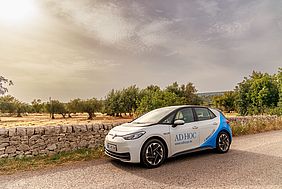
In May 2024, my wife and I set off on a six-week road trip to Italy. What made it especially adventurous: we travelled in an electric car, our VW ID.3.
We were unsure whether Italy’s charging infrastructure would be good enough to make it all the way to Sicily and back. We had heard quite a few horror stories and encountered many surprised faces along the way.
The first real test came at the Brenner Pass, where the steep climb quickly drains the battery range. However, we had previously checked the EnBW app and found plenty of charging stations along the route.
Route planned with precise charging stops
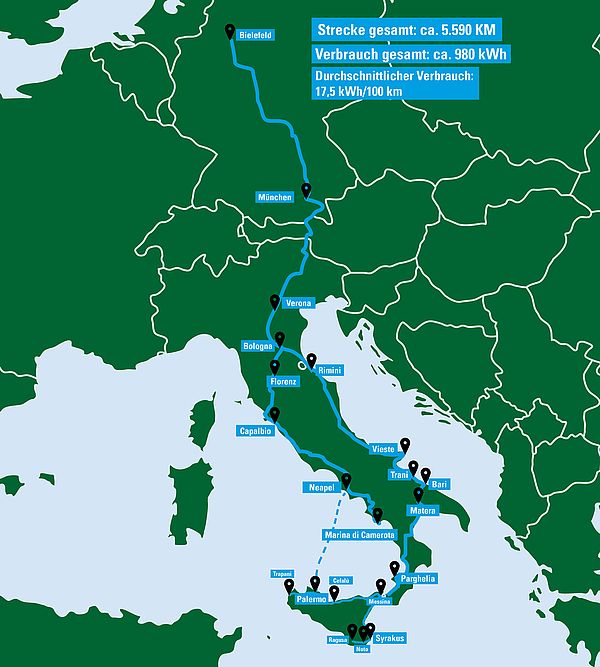
On the way from Munich to Verona – our first stop in Italy – we only needed a single charging stop. In Verona, I found a charging station near our accommodation. The charger accepted my EnBW charging card without any issues. Although the station only delivered 10 kW, we could simply leave the car charging until it was full again. We had planned to take the bus into the city anyway.
To ensure we could reach each next stop on a single “tank”, we carefully selected our destinations in Emilia-Romagna. The next day we travelled from Verona to Modena, known for its balsamic vinegar and, of course, racing legend Enzo Ferrari, and then on to the area near Bologna. Overall, it was only about 150 kilometres per day. Since our accommodation in the hills near Bologna had no charging facilities, we charged en route.
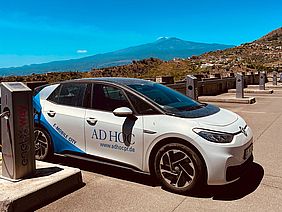
The next day we drove directly to a charging station near Bologna’s historic city centre. Not because we needed to charge, but because it made parking easier. You do have to pay an idle fee if you stay too long at a charger, but similar parking fees would have applied anyway. It is rather unlikely that you are blocking someone else’s charging opportunity. We rarely saw an occupied charging station – and if we did, it was usually a combustion engine car parked there instead. My personal impression: Italians seem less convinced about e-mobility than Germans – at least for now. When we did see electric cars, they were mostly driven by tourists in popular destinations.
Charging options at almost every motorway service station
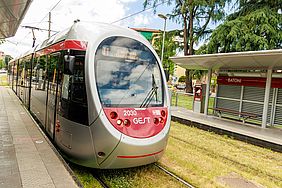
Next, we continued to Florence, just 140 kilometers away. Via the A1 motorway, this was no problem. Even though energy consumption increases on highways and reduces the driving range, this leg was manageable without a charging stop. If necessary, charging stations can almost always be found at major motorway service areas along the route. In Florence, we again used the well-developed public transport system. In fact, the city even has trams!
From Florence, on our way to Naples, we planned a stop at the Tarot Garden by artist Niki de Saint Phalle. For this, we drove to the southern edge of Tuscany, to Capalbio. In total, the journey covers about 200 kilometers on more or less well-maintained country roads. Charging stations are rather scarce and mostly found in tourist hotspots such as Siena. Near Grosseto, just before our destination, we stopped at a fast-charging station because we were unsure about charging availability in the rural area around Capalbio.
View of a construction site behind a fence
Our concerns turned out to be unfounded, because the next morning before continuing our journey to Naples, we discovered a supermarket with fast-charging stations. While the car was charging, we enjoyed cappuccinos and sweet cornetti filled with cream in a nearby café. After that, we set off for 352 kilometers on the Autostrada (motorway). Even though we drove at only 110 km/h, the battery was not quite enough for the full distance, so we had to make a charging stop along the way.
With 60 kilometers of remaining range, we arrived at the planned charging stop at a motorway service area. There, we could see the charging stations, but they were inaccessible behind construction fences, even though they were listed as operational in the app. Very frustrating! We had to find an alternative, as the next charging option on the motorway would no longer be reachable. In the app, I found another small charging station only 15 kilometers off the motorway. So we followed the navigation at reduced speed to the next exit and the new destination.
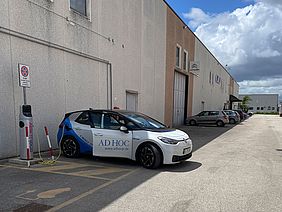
Public electric charging station in a small industrial area
We entered a small industrial area and became increasingly doubtful that we would actually find a publicly accessible charging station there. But in fact, there was one at the end of the industrial zone, in front of a warehouse. I was already wondering who would plan a public charging station in such a place. But at that moment it did not matter, because with 40 kilometers of remaining range we could now plug in the car and charge it, albeit very slowly.
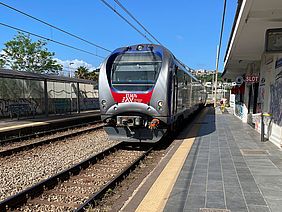
Once we had reached 150 kilometers of range, we drove the remaining distance directly to Pozzuoli on the Gulf of Naples. There we found the next fast-charging station. From Pozzuoli we took the train into Naples, about 20 kilometers away, since traffic in the city of 900,000 inhabitants is quite challenging.
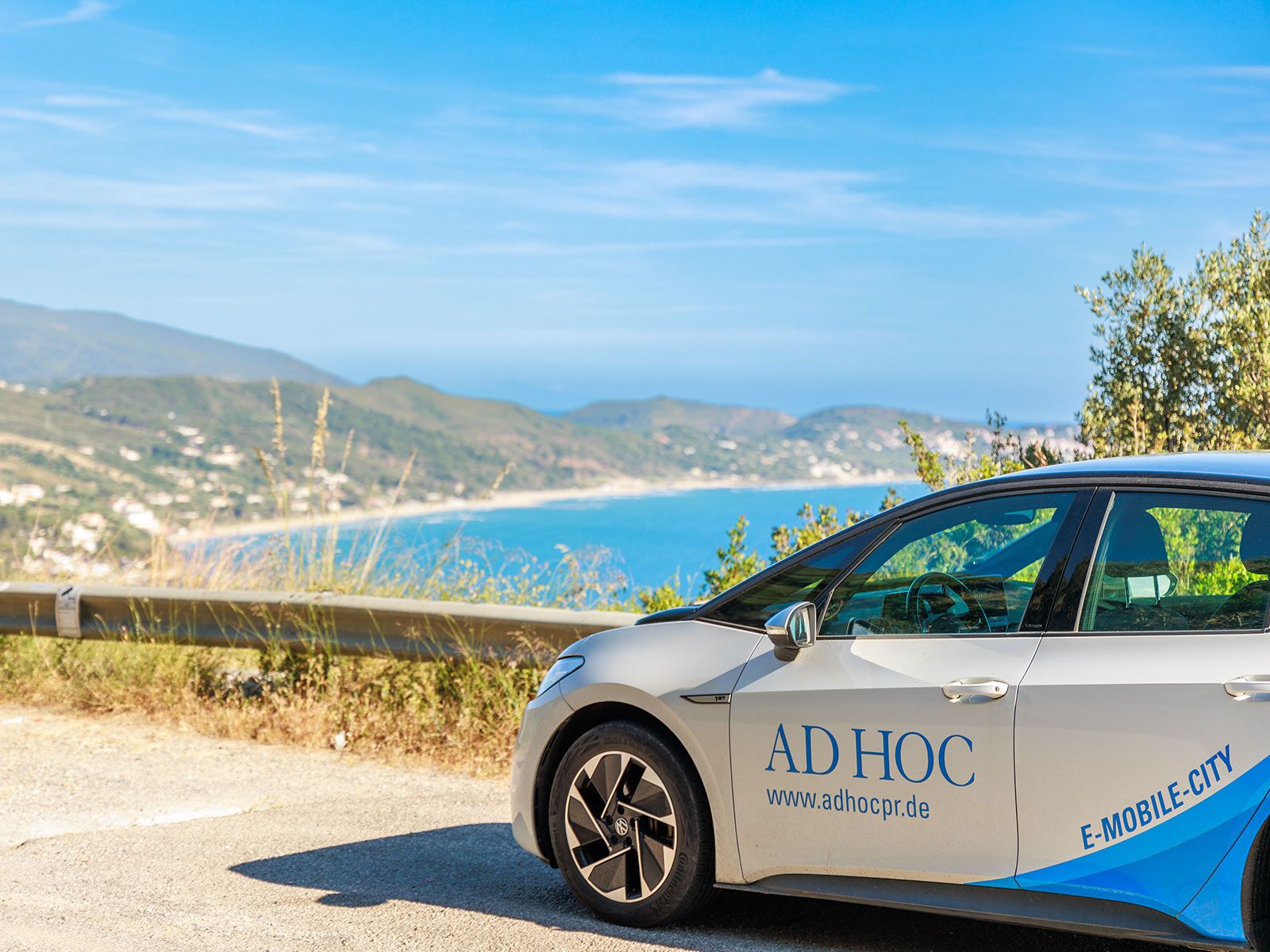
The next “charging adventure” awaited us in Calabria: after a relaxed morning at the beach and a leisurely siesta on our terrace with sea view in Marina di Camerota, we wanted to quickly drive to the neighboring town of San Giovanni a Piero to charge the car. While climbing the winding mountain roads, we could watch the remaining range drop steadily. That makes you a bit uneasy, especially after our experience that app data in Italy is not always reliable. So we were not quite able to enjoy the beautiful views high above the sea. Our destination allegedly ended up being in front of a closed villa gate, with only 60 km of range left. Frustrating!
So first, we asked the locals. Yes, there was supposed to be a charging station at the piazza. After some searching through the maze of narrow streets, we discovered a slow charging station, and luckily it worked! Phew! Now we just had to spend some time there, which turned out to be a great opportunity to explore the town.
While walking around, our now trained eyes spotted yet another fast-charging station! We quickly parked in the one available spot, as the second one was already being misused by a combustion engine car. After that, we could stroll through the town much more relaxed.
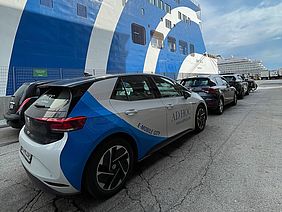
Later, we returned to Naples to take the night ferry to Sicily. Traveling with an electric car was no problem at all. There were no special rules or restrictions.
Well-developed charging infrastructure in Sicily
In Sicily, we found a very well-developed charging infrastructure. On all our trips, we were able to charge without any problems. The longest distance we covered there was from Castellammare del Golfo, west of Palermo, to Syracuse. The ferry crossing from Messina back to the mainland three weeks later also went smoothly. The ferry ride itself takes just under 30 minutes.
Our destinations in southern Calabria and Apulia were also easily accessible. There are well-developed express roads and motorways, and charging stations can be found in all cities.
The long journey from the beautiful Gargano National Park in the spur of Italy back to Germany was completed smoothly with two stops in Rimini and Memmingen, especially because the Adriatic motorway is very well developed. This allows for regular fast charging stops and relaxed driving along the coast using cruise control.
Our conclusion
On the trip, we were approached by surprised tourists from Münster who asked whether we had really managed the entire journey in an electric car. “Of course,” I could only reply. A car like the ID.3 is more than sufficient for this kind of trip.
It has to be said that travelling by electric car is truly very relaxing and slows things down in a pleasant way. If you plan your route carefully in advance and carry an app and/or charging card with you, you won’t get stranded. The tour through Italy was really great, and travelling by electric car made it an enjoyable experience.
In the end, we used around 980 kWh for the 5,590-kilometre journey from Bielefeld to Sicily and back. That corresponds to an average consumption of 17.5 kWh per 100 km — very efficient indeed. For comparison: on long-distance trips, due to lower levels of regenerative braking than in city driving, anything under 20 kWh/100 km is considered very economical.
The full trip to relive: www.sdwrts.blog