
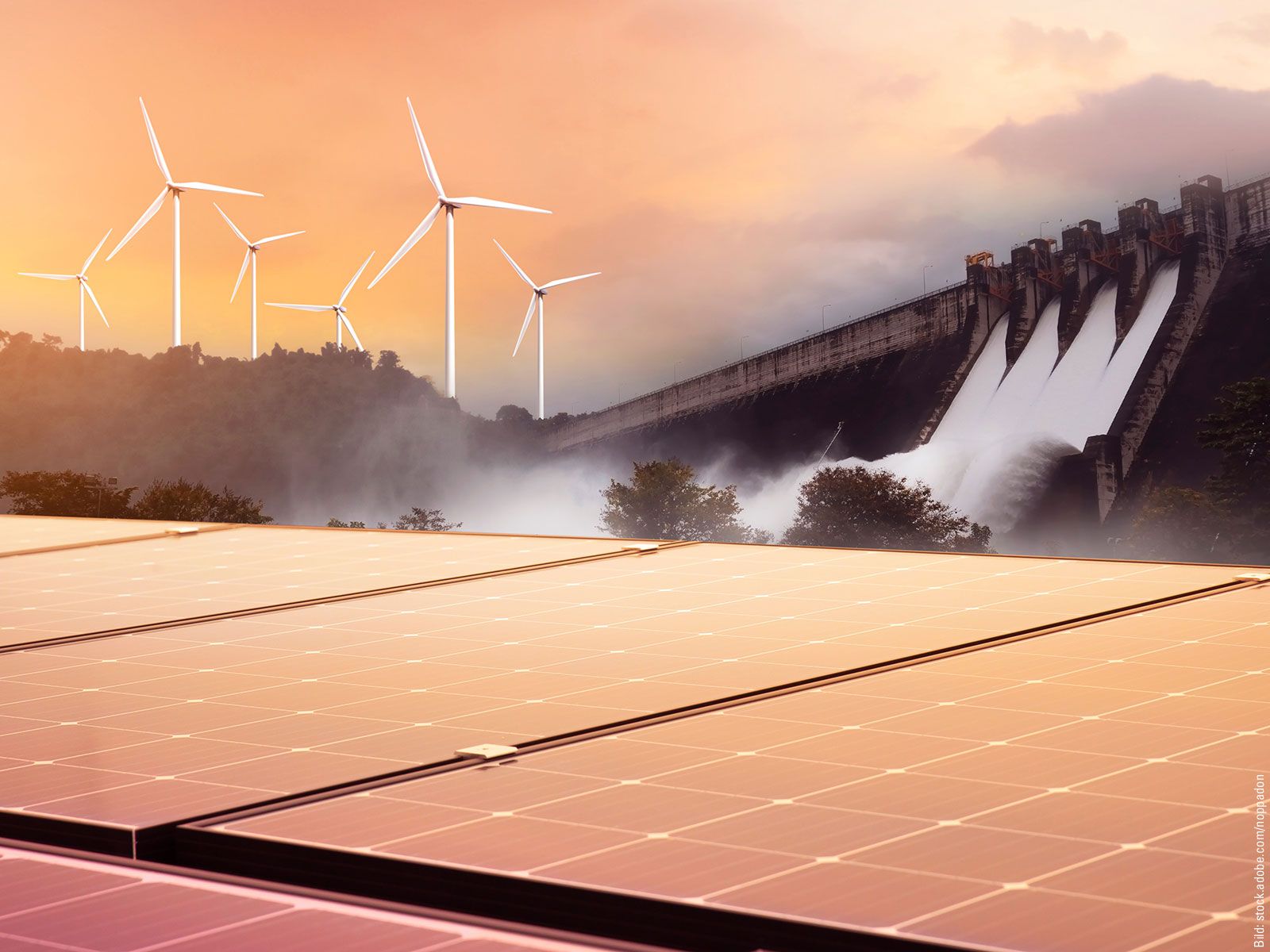
News: Renewable energies account for 50.3% of Germany’s gross electricity consumption
The share of renewable energy in Germany’s electricity mix is increasing: in the first quarter of 2023, wind power, solar energy, and biomass together supplied more than half (50.3%) of gross electricity consumption. This is slightly higher than in the same period the previous year.
The figures are preliminary. They come from the German Association of Energy and Water Industries (BDEW) and the Centre for Solar Energy and Hydrogen Research Baden-Württemberg (ZSW). According to them, renewables supplied 69.5 of the 138.1 terawatt hours (TWh) consumed from January to March.
- Onshore wind turbines contributed 27% (just over 38 billion kWh),
- Biomass 8% (just over 11 billion kWh),
- Solar photovoltaics 6% (almost 8 billion kWh),
- Offshore wind turbines 5% (7 billion kWh),
- Hydropower 3% (4 billion kWh)
Among fossil energy sources, lignite remained the most widely used (26 billion kWh), followed by natural gas (23.3 billion kWh) and hard coal (17 billion kWh). Nuclear power accounted for only 6.2 billion kWh in the first quarter of 2023, making it a marginal contributor. Germany’s last three nuclear power plants were taken off the grid shortly afterwards, on April 15, 2023.
Overall, gross electricity consumption in Germany fell by around 6.4% in the first quarter of 2023 compared to the same period in 2022. This crisis-related reduction in demand is one of the reasons for the increased share of renewable energy.
The next winter can come
The head of Germany’s Federal Network Agency, Klaus Müller, is already optimistic regarding the upcoming cold season: “Electricity supply next winter is as secure as we have been used to in many years.” However, he sees “a challenging situation with high demand in the south and a large amount of renewable generation in the north.” Therefore, rapid grid expansion is essential for the energy transition, while also improving overall grid stability.
Sources: BDEW, Federal Network Agency
