
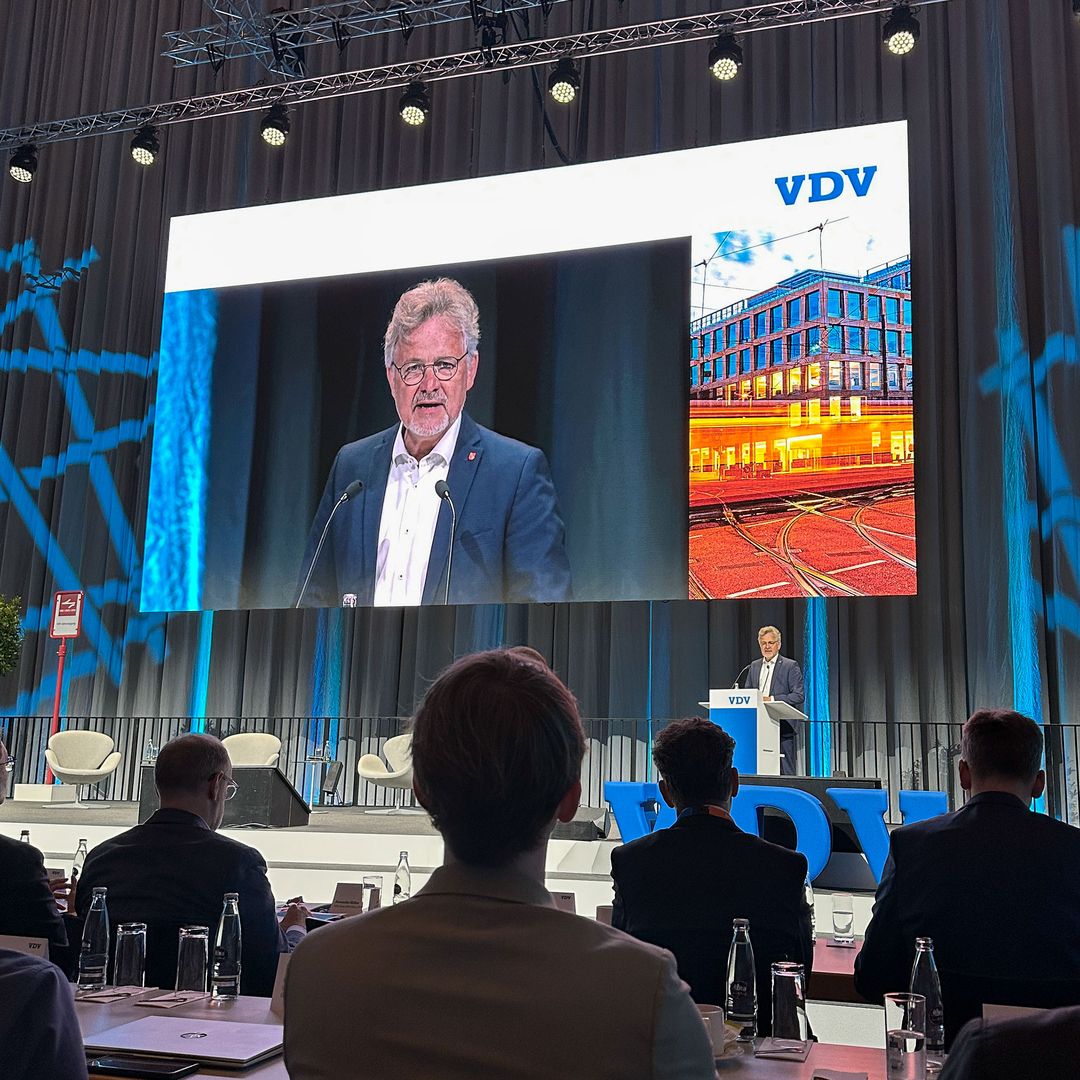
There is a good reason why the VDV Annual Conference 2026 took place in Karlsruhe: the “Karlsruhe Model” has demonstrated since the 1990s how a city tram network can be combined with regional railway lines in the surrounding area so that passengers can travel directly into the city center without changing trains.
This innovative concept with so-called “dual-system vehicles” has also been adopted in other European cities, from Sheffield and Nantes to Nordhausen, Szeged, Lyon, and Cádiz.
The region is now also making headlines in the field of #autonomous driving: the Karlsruhe Transport Authority (KVV) is taking on central coordination of a test field for automated driving. Speaking at the VDV Annual Conference, Karlsruhe’s Lord Mayor and KVV supervisory board chairman Dr. Frank Mentrup said in his keynote:
“We are very proud that our public transport system is also at the center of an autonomous test field that does not take place on some isolated route at the edge of the city, but right in urban traffic and highway traffic around Karlsruhe — in other words, in every imaginable traffic situation. This provides an excellent and important foundation for the development of modern sensor technology and many other technical solutions.”
Dr. Mentrup addressed two requests to policymakers:
- The “quarreling between the federal states and the federal government that has accompanied us intensely in recent years” must end. It is important to reach a “shared acceptance of the absolute necessity of public transport as a key element of public services.” In plain terms: “Instead of wrangling over 300 million euros for a Germany ticket, we should focus on future challenges.”
- “Please be bold and bundle technical challenges at the federal level and advance standardization in a timely manner,” Dr. Mentrup added.
It no longer makes sense for every transport operator to independently drive the transition to autonomous driving through individual funding projects and partnerships with science and industry. Instead, the mayor proposed a competition to identify the best technical solution and adopt it as a standard for all. “The sensor technology alone that we need to install to automate just a few kilometers of tram line in open terrain exceeds our financial capabilities. We will only manage this leap into modernity if, in the end, as many as possible jointly order the same sensors from a company that emerges from such competition. Only then will costs reach economically viable margins.”
His conclusion: “In the end, we need not only the courage to fund and launch pilot projects, but also the courage to implement their findings and results nationwide.”
