
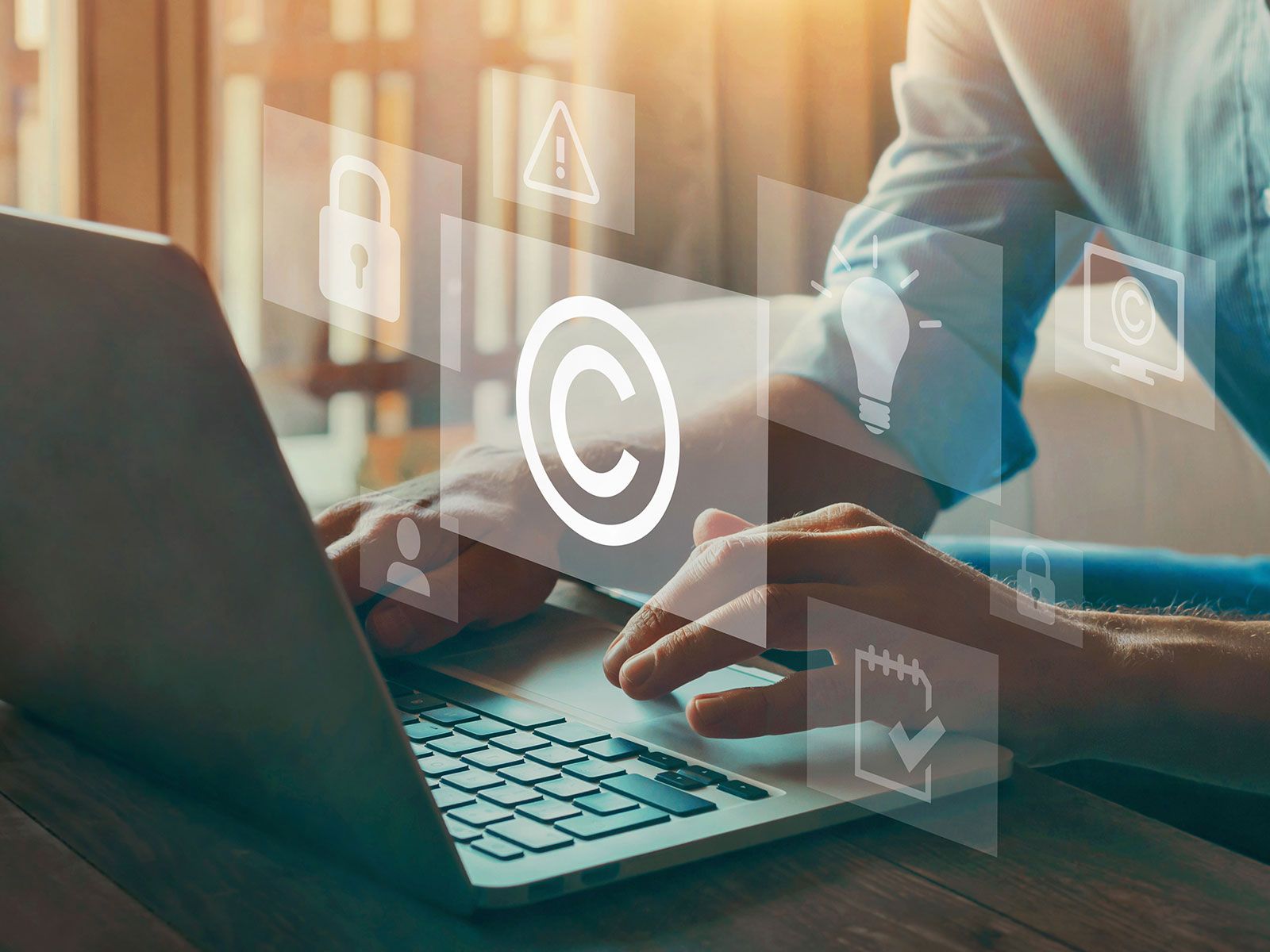
Whether music files, images, maps, or texts—content on the internet is generally protected and must not be redistributed by companies without caution. In Germany, the creator holds the rights to their intellectual property, which means it cannot be used without their personal consent. If it is used without permission, this constitutes a copyright infringement, which usually results in a request to remove the content. However, copyright infringement can also have civil law consequences. A formal warning (cease-and-desist letter) may be issued, in which claims such as injunctive relief or compensation for damages can be asserted.
Copyright applies to works in literature, science, and art. This includes music, newspaper articles, photographs, or artworks that are personal intellectual creations and based on the individual effort of a person, reflecting their personal characteristics. Unlike patent protection, copyright does not need to be formally registered; it arises automatically upon creation of the work—even if it has not been published. This means that a sketch or the manuscript of a book is protected just as much as a published bestseller. These highly personal rights cannot be transferred or waived. As a result, the author has extensive rights to determine the use and exploitation of their works, namely usage and exploitation rights, which can be transferred to third parties. If several people have jointly created a work, they are considered co-authors and share rights and obligations.
Protected works in social media
Even though copyrighted works may be used as private copies, the question arises as to how “private” platforms such as Facebook and others actually are. In principle, content may be shared on social media if the author has enabled the share function. In doing so, they automatically consent to their content being shared. However, if a user publishes a post containing text or images from another person without their consent, this may lead to a formal warning. Linking content, on the other hand, is generally permitted on all platforms.
Images
Photographs, images, or drawings are generally protected by copyright and must not simply be distributed on social media. This also applies to photos of celebrities, comic characters, or cartoon figures that are often used as profile pictures. In such cases, the copyright lies with the illustrator or photographer, from whom a license for use can be obtained. However, the use as a profile picture is rarely prosecuted, as many rights holders consider it free advertising. Even if images come from a database, they may not automatically be used for social media. In some cases, a separate usage right must be acquired via the respective platforms. The author always has the right to be credited, which can also be enforced in court. Even if an image has been edited, the copyright remains in place. It does not become a new original work, so the author’s consent is still required.
Music
The same applies to music used, for example, as background audio in video productions. If the video is private and intended for family use, usage is less problematic. However, once the video is uploaded to a public platform, it may result in a formal warning. In such cases, it is better to use royalty-free music, which can be found online on platforms such as Audihub.
Texts
Texts may also not be copied if they are individual and creative works. This applies, for example, to press releases, essays, and poems, provided the author has not already been deceased for 70 years (e.g. Goethe or Schiller). If this is not the case, permission from the author is required for publication. In theory, this could also apply to a tweet, although this is rather unlikely.
Social media recommendation
- It is best to use your own content or agree in advance with the rights holder.
- When sharing a post, always check carefully whether distribution has been explicitly permitted.
* The information in this article is of a general nature and does not constitute legal advice. No liability is assumed.
