
Whenever we travel, we almost always test the local public transport system. This was also the case in Bilbao, a city with around 350,000 inhabitants in Spain’s northern Basque Country.
Football fans think of Athletic Bilbao, while culture lovers praise the Guggenheim Museum. Less well known is that Bilbao’s public transport system is considered one of the best—if not the best—among 21 major Spanish cities, at least in terms of punctuality and comfort. This was confirmed by a survey conducted by the Organization of Consumers and Users (OCU).
Metro lines, trams, and buses work together seamlessly. All of them have contributed to the so-called “Bilbao effect”. This refers to the pull effect created by the Guggenheim Museum since its opening in 1997, attracting tourists from all over the world. Around one million visitors come to the former industrial city each year, which has transformed into a cultural hub. Without a well-designed public transport system, it would hardly be possible to move these large numbers of people efficiently and comfortably.
Trams are the most popular mode
What makes Bilbao’s public transport so attractive? Here are some key points:
The clear favourite among users is the tram, which scores a perfect 100 out of 100 points.
Need to get to the beach 13 kilometres away? No problem with the metro. The first of three lines opened in 1995. Today, the metro (user rating: 86 out of 100 points) is considered the most important transport mode across the metropolitan area. It connects suburbs along the River Nervión all the way to the coast and further along the Bay of Biscay.
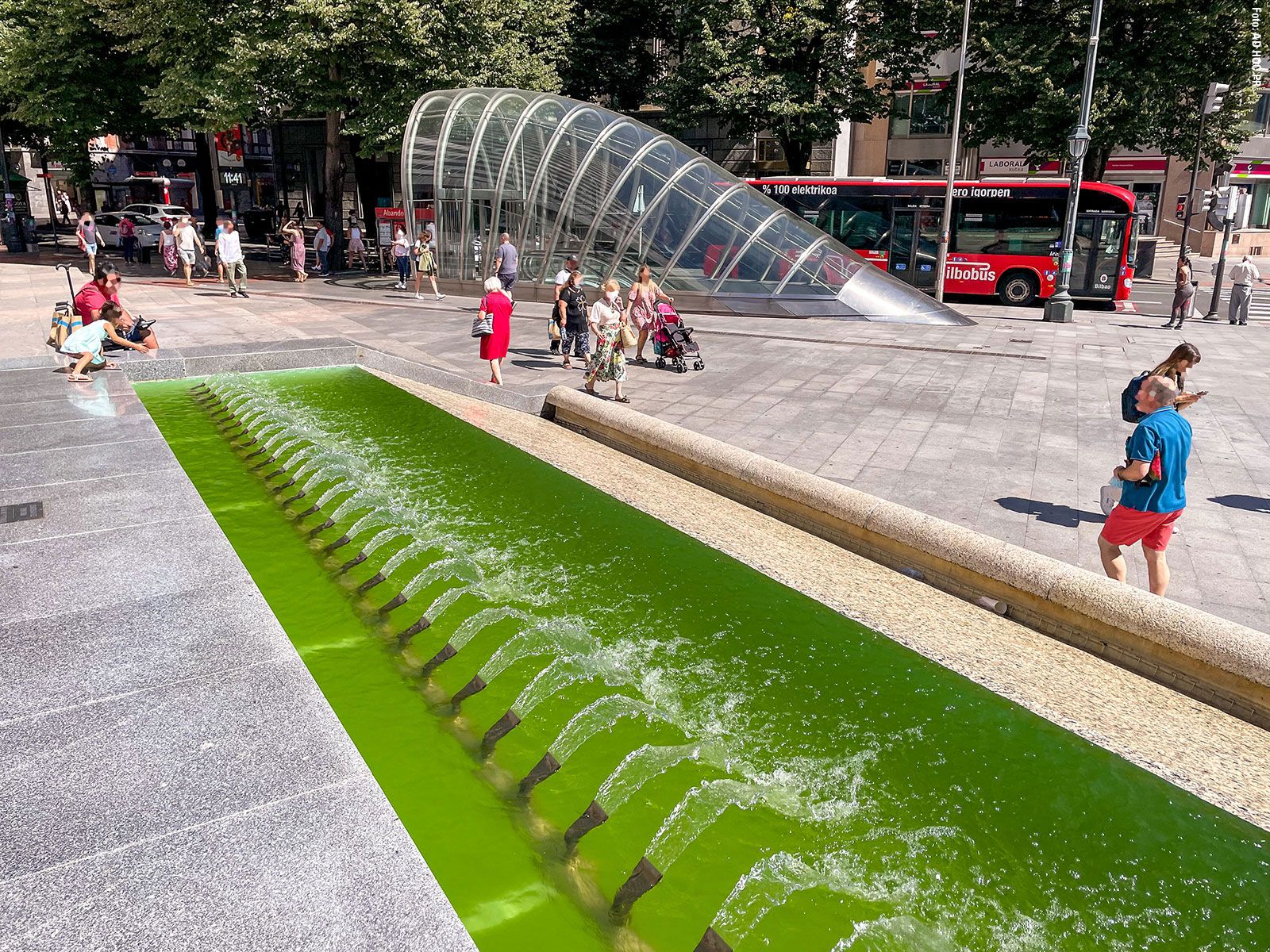
As in many parts of Bilbao, art is also present in the metro system: the entrances are already striking, designed in a modern post-industrial style with curved glass structures resembling shells. They are popularly known as “Fosteritos”, named after star architect Norman Foster, who designed, among other things, the glass dome of the Reichstag in Berlin. The “Metro Bilbao Station” in the southern part of the city also bears the signature of Norman Foster and partners.
No more than 300 metres to the next stop
An extensive bus network operated by two major providers also covers the city and surrounding area. With 44 lines and 525 stops across the urban area and nearly 16 million users in 2020, 99.8% of Bilbao’s residents—virtually everyone—live no more than 300 metres from the nearest stop.
- “Bilbobus” operates 141 buses on its own. Sixty vehicles in the fleet are hybrid, and eleven are fully electric. Of the remaining combustion-engine buses, 106 run on “BIO 10%” fuel.
- “Bizkaibus” complements the metro and rail services by connecting other districts. The buses serve the airport as well as tourist attractions across the region. Bizkaibus also operates hybrid and electric vehicles.
A surprising sight in this hilly city:
Public lifts. They conveniently transport residents to higher-lying neighbourhoods. Just recently, three new ones were added. This is a real benefit for local communities, especially where many elderly people live. In addition, a funicular railway (“Furnicular de Artxanda”) takes visitors up to a popular viewpoint as well as to sports and leisure facilities in the surrounding green areas.
For those who enjoy walking: Bilbao’s pedestrian zones are also impressive. They account for one fifth of the entire road network. In this respect, Bilbao is considered a pioneer in Spain, ahead of cities such as Barcelona and Valencia.
However, the cycling infrastructure receives rather poor marks. While rental stations near the river benefit from relaxed cycling routes to tourist attractions, the overall network remains underdeveloped. Cycling in Bilbao requires a certain level of fitness to navigate traffic among cars and trucks. City planners should, however, be given credit for the fact that bicycles are not necessarily the ideal mode of transport in many steep and narrow streets.
Although located a little further outside Bilbao, the “Puente de Vizcaya” transporter bridge absolutely deserves a place on our “satisfaction list” (as reported on social media). It connects the suburbs of Portugalete and Getxo and helps improve accessibility across the metropolitan area. It saves residents a detour of up to 20 kilometres. In just 90 seconds, passengers can cross the River Nervión before it flows into the Bay of Biscay. The transporter bridge is a UNESCO World Heritage Site and a very strong example of successful transport planning that has been in use for more than 100 years.
