
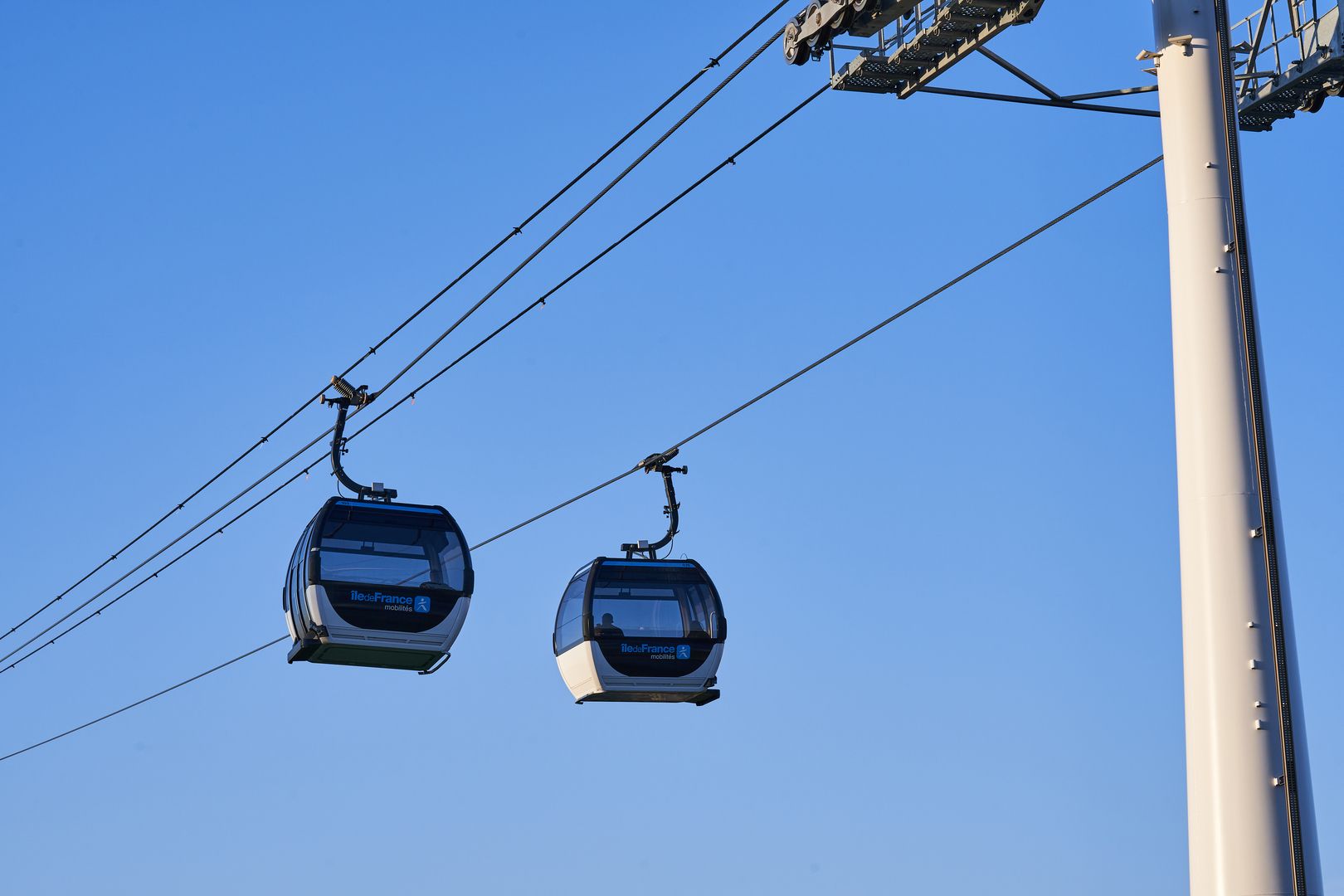
The longest urban cable car route in Europe creates uplifting experiences in the “City of Love” 💞: Since mid-December 2025, gondolas have been floating through the air in Paris. In combination with the metro, they connect five suburbs in the southwest with the city center of the French capital — an advantage for countless commuters from the “banlieues.”
The record-breaking “Câble C1” route is, according to the responsible authority Île-de-France Mobilités (IdFM), 4.5 kilometers long and runs from Villeneuve-Saint-Georges to Créteil – Pointe du Lac 🚡. The C1 line features 105 cabins, each with ten seats. Up to 11,000 passengers per day are expected. The operator is Transdev Coteaux de la Marne.
Other European cities are also increasingly relying on urban cable cars as a complement to public transport (ÖPNV), for example in Barcelona, London, and Toulouse.
The world’s largest urban cable car systems are, however, located in Latin America (based on manufacturer and operator data).
- Rank 1: “Mi Teleférico” connects the cities of La Paz and El Alto in Bolivia. With a total system length of 33 kilometers, it is the largest urban cable car network in the world.
- Rank 2: “Cablebús” in Mexico City, Mexico. The total route length exceeds 24 kilometers.
- Rank 3: “Metrocable” in Medellín, Colombia. The system spans 15 kilometers in total.
In Germany, several cities are planning to integrate cable car systems into their public transport networks.
Examples:
- In Herne, the future innovation district Blumenthal is planned to be connected to Wanne-Eickel station via a cable car across a former coal and power plant site.
- In Bonn, the cable car project has moved “a significant step closer” to realization, according to the city. If everything proceeds as planned, the approximately 3.8-kilometer-long cable car will connect Beuel on the right bank of the Rhine with the University Hospital on Venusberg from 2032 onward.
- The city of Heilbronn also plans to build a cable car, ideally running from the “Experimenta” science center via the Bildungscampus West and Zukunftspark Wohlgelegen to the Innovation Park Artificial Intelligence (IPAI). The preferred route would be 5 kilometers long, which would make Heilbronn a potential challenger to Paris as Europe’s leading system.
Sources: Île-de-France Mobilités, ARD, City of Heilbronn, Transdev, SZ et al.
