
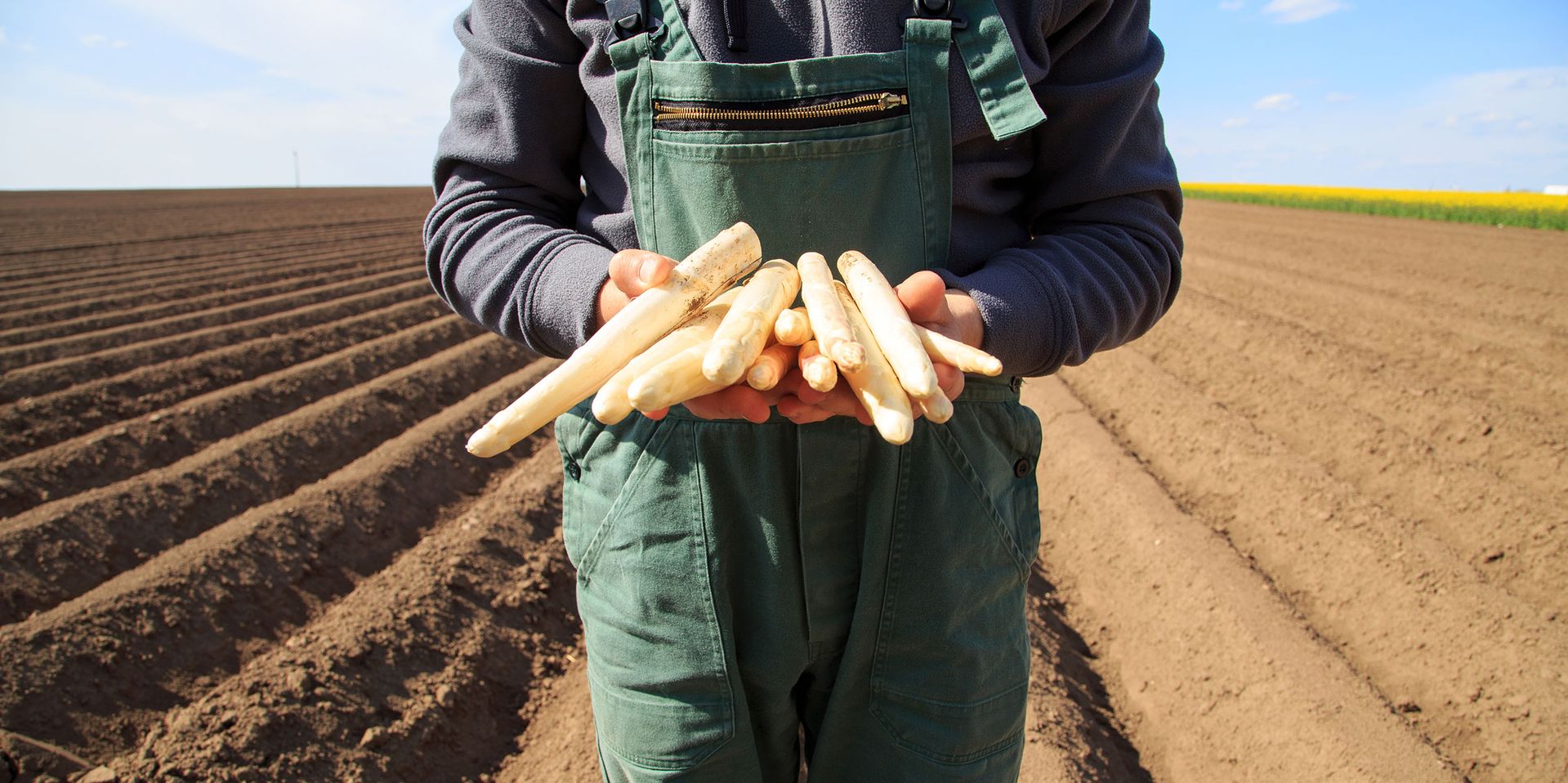
Whether served classically with hollandaise sauce, as a soup, or in a salad: On average, every person in Germany consumes around 1.4 kilograms of asparagus per year, according to the Federal Ministry of Food, Agriculture and Homeland (BMLEH). Nevertheless, asparagus ranks only 10th among the most popular vegetables, which may also be due to its price: premium class asparagus can cost 20 euros or more per kilogram, while broken asparagus is available for around 12 euros per kilogram.
In 2025, Germany harvested 103,900 tons of asparagus. That is 3.9 percent less than in the previous year and 8.5 percent less than ten years ago, according to the Federal Statistical Office. Over the same period, the cultivation area in Germany decreased from 25,700 hectares in 2015 to 22,500 hectares in 2025 — a decline of 12.5 percent.
Overall, the number of agricultural farms growing asparagus declined even more sharply than yield and cultivated area suggest: in 2025, only 1,350 asparagus farms remained. Ten years earlier there were 1,900. This corresponds to a decrease of 29.3 percent — nearly one third.
The highest number of asparagus farms can be found in the following federal states:
- 290 farms in Bavaria
- 265 in North Rhine-Westphalia
- 210 in Baden-Württemberg
The largest cultivation areas are located in:
- Lower Saxony (4,300 hectares)
- North Rhine-Westphalia (4,100 hectares)
- Brandenburg (4,000 hectares)
4,500 tons of asparagus grown in Germany were exported in 2025. On the other hand, 24,500 tons of imported asparagus entered domestic vegetable shelves — mainly from Spain, Mexico, and Greece.
